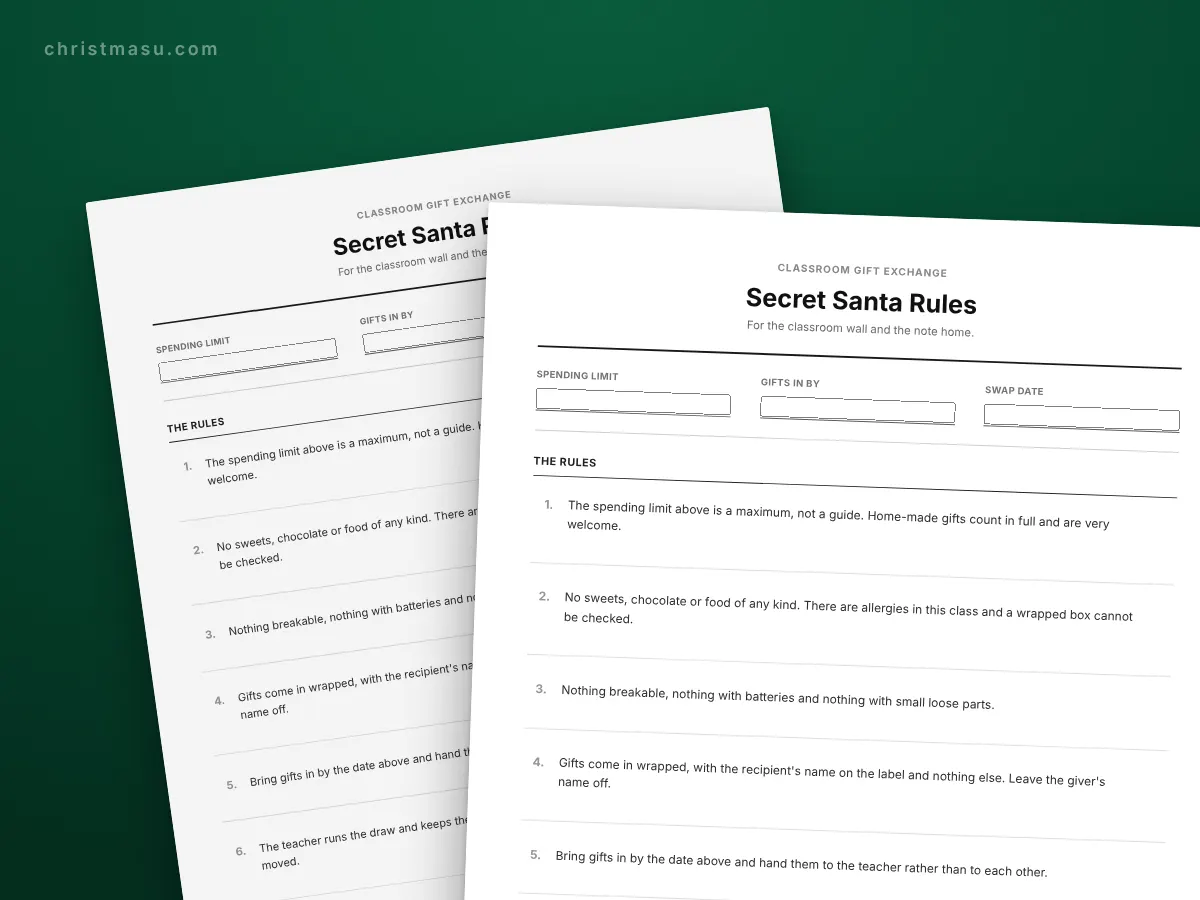
Written for a teacher or a class rep. Eight rules covering the spending cap, food, breakables, how gifts come in, who runs the draw and what happens to a child who does not bring one. Fill in the limit and the two dates, then print one for the wall and one to copy home.
The cap has to be low, and it is a maximum
In a classroom the figure is not about fairness between gifts, it is about not exposing which families have money. Three to five pounds or dollars is the usual cap. The printed rule says it is a maximum rather than a guide, and that home-made gifts count in full and are very welcome.
Rule seven is the one that matters most: spare gifts are kept aside, so every child opens something on the day whatever else happens. That single line is the difference between an inclusive activity and a sorting exercise.
Food, allergies and what not to send in
The second rule is no sweets, chocolate or food of any kind, and it is written exactly that way for a reason: a class usually contains at least one serious allergy, and a wrapped box cannot be checked by the child receiving it. Ruling out all food is simpler and safer than listing exceptions.
Rule three covers the rest: nothing breakable, nothing with batteries and nothing with small loose parts. If your school policy is stricter, add it by hand before you copy the sheet.
The draw, with an adult holding it
Rule six puts the teacher in charge of the draw and the list, and invites any child to come and say quietly if they would like their name moved. Children redrawing in front of each other turns into a negotiation, and a difficult pairing needs a quiet swap rather than a public one.
Rule four keeps the giver name off the label, which is the thing children get wrong most often and the thing that makes the swap itself work.
The copy that goes home
Print a second copy and send it home as it is. Eight short rules, a cap, a date and the line about spare gifts tells a parent everything they need, and a short note gets read where a long letter does not.
The last rule is written for parents rather than children: if your family would rather not join in, say so, nothing is said about it and nobody is asked twice.
Questions
- What budget should a classroom Secret Santa have?
- Three to five pounds or dollars, written into the spending limit line as a maximum. The printed rule says home-made gifts count in full, which keeps the cap from showing which families have money.
- Should food be allowed as a gift?
- No, and the sheet says so outright: no sweets, chocolate or food of any kind. A class usually contains at least one serious allergy, and a wrapped box cannot be checked by the child receiving it.
- What about a child whose family cannot take part?
- Rule seven covers it: spare gifts are kept aside so every child opens something on the day. Hold a few back yourself and hand them out without comment.
- Who should run the draw?
- The teacher, keeping the list. The printed rule invites any child to ask quietly for their name to be moved, which lets you fix a difficult pairing without it becoming a discussion.