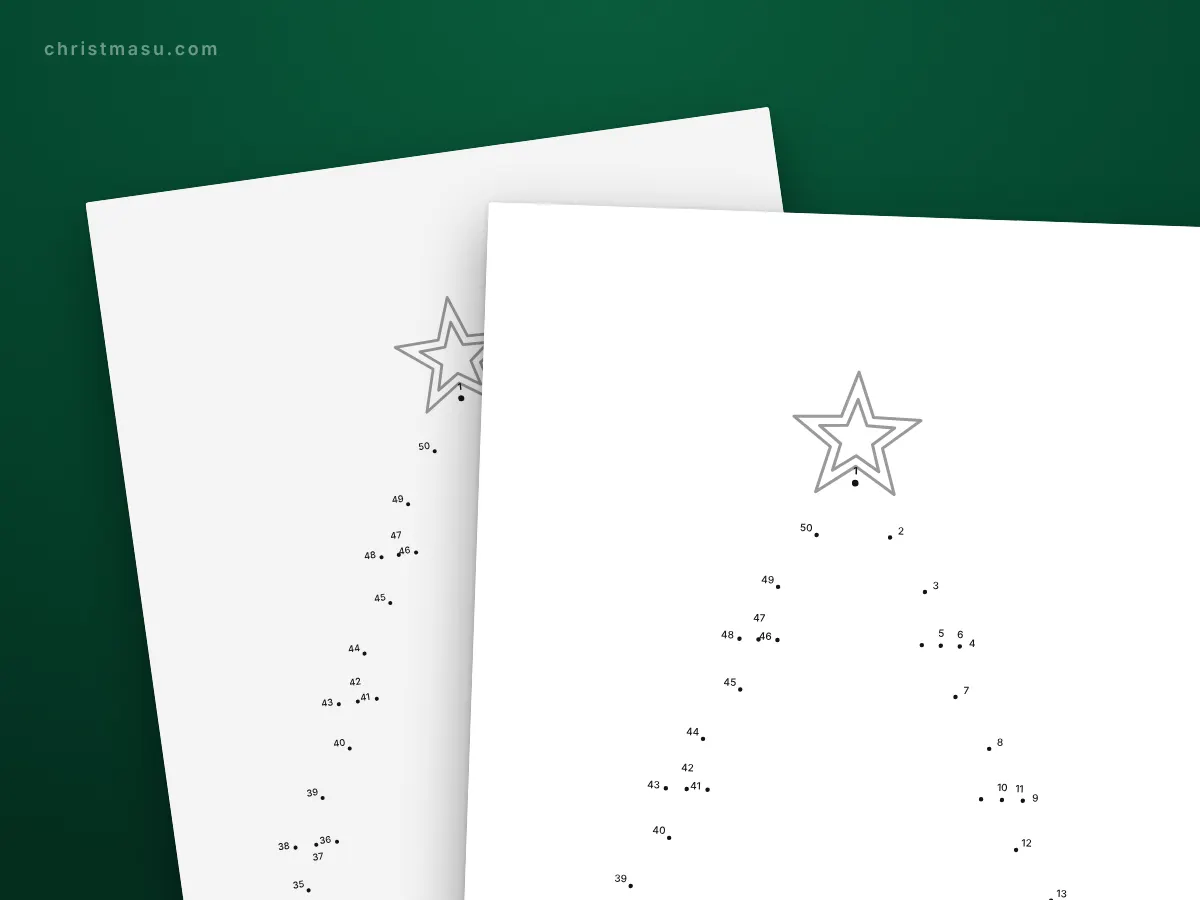
Four pictures that appear as you join the numbers: a Christmas tree, a star, a snowman and a bauble. Count to twenty, fifty or a hundred, and the dots are placed again to match. The parts of the drawing that are not on the route print faintly, so a half-finished sheet still reads.
Dot count and age
Twenty dots gives a chunky shape a four year old can follow. Fifty gives a recognisable outline with curves, which suits a child of six to eight. A hundred is for eight and up, where the point is the counting as much as the picture.
The number sits beside each dot rather than on it, and the route never crosses itself, so a child who loses their place can pick the sequence back up by looking rather than by starting again.
The faint parts are a hint
Each picture has one outline that carries the numbers and the rest printed in pale grey: the star on top of the tree, the snowman's hat and buttons, the cap on the bauble. That tells a child what they are drawing without doing the drawing for them.
It also means a sheet abandoned at dot thirty still looks like something, which matters more with a four year old than it sounds.
Then colour it in
The joined picture is a plain outline, so the sheet turns straight into a colouring page. That doubles the time it occupies a child, and it means a dot to dot that went slightly wrong still ends up looking finished.
Questions
- How many dots should I use?
- Twenty for a four to six year old, fifty for six to eight, and a hundred for eight and up. The picture is the same at every count, so you can match the sheet to the child rather than the other way round.
- Which pictures are there?
- Four: a Christmas tree, a star, a snowman and a bauble. Press Redraw for a different arrangement of dots around the same picture.
- Can a child colour the picture afterwards?
- Yes. Joining the dots leaves a plain outline drawing, so every sheet becomes a colouring page once it is finished.
- Is there a hint for a child who gets lost?
- The parts of the drawing that are not on the numbered route print in pale grey, so there is always a clue to what the picture will be without giving away the order.