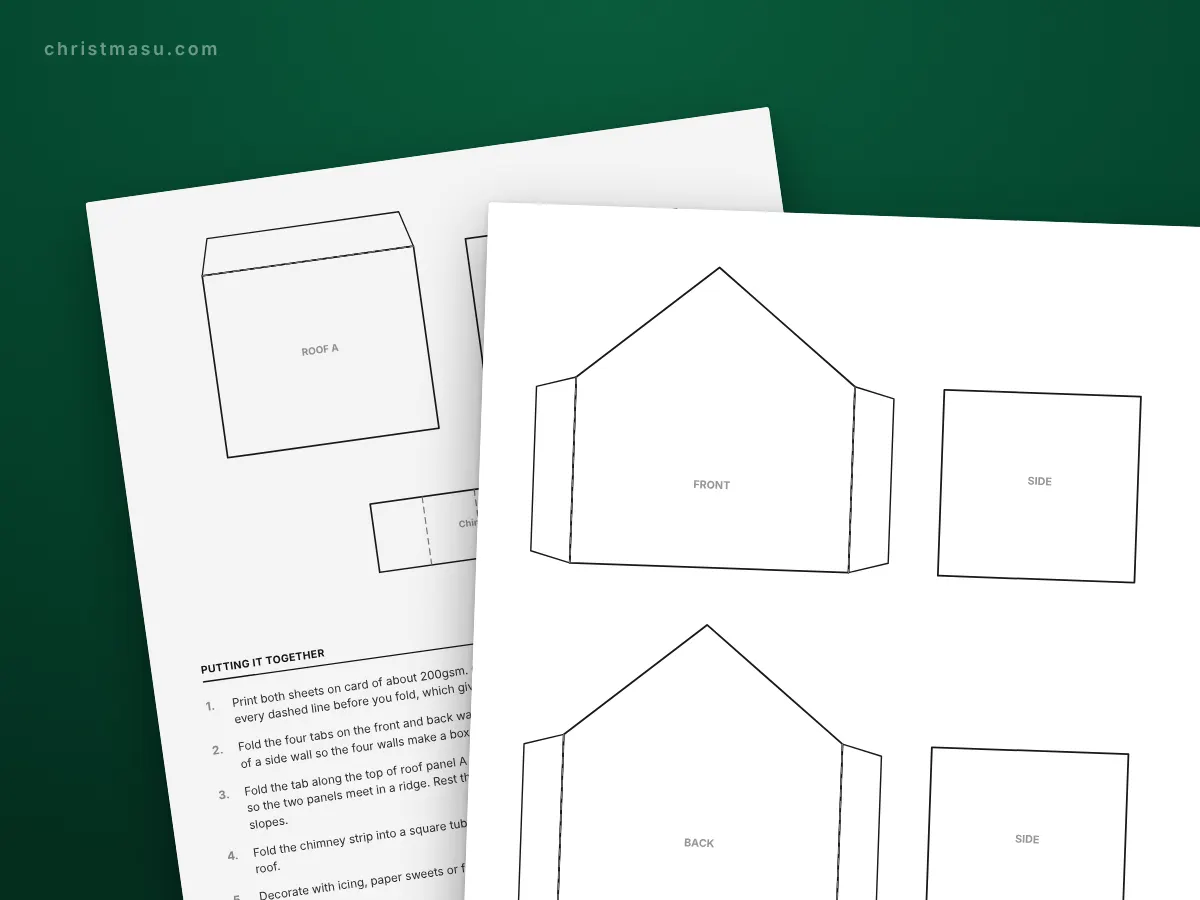
Two sheets. The first carries the front and back gable walls, each with a fold tab down both sides, and the two square side walls. The second has the two roof panels, a chimney strip and the five assembly steps printed underneath, so the instructions cannot get separated from the parts.
The tabs are what make it stand up
The front and back walls each have a narrow tab down both edges with a dashed fold line. Fold all four inwards and glue each one to the inside edge of a side wall, and the four walls become a box with an open top. That is the whole wall assembly, and it is why there are no tabs on the side walls.
Roof panel A has a tab along its top edge. Glue it under the edge of panel B so the two meet in a ridge, then rest the roof on the gables and glue along the slopes. A roof that meets at a tab holds. A roof butted edge to edge does not.
Solid cuts, dashed folds
Cut along every solid line and score along every dashed one before you fold anything. On 200gsm card an unscored fold cracks and the white core shows along the ridge, which is the part everyone looks at.
The chimney is a single strip with three fold lines and an end tab. Fold it into a square tube, glue the tab, and stand it on the roof. It is the fiddliest piece and the one worth doing first while your patience is intact.
Using it with dough
Cut the panels from card, not paper, and lay them on rolled dough rather than pressing. Cut round with a knife held vertically, because an angled cut gives you panels that do not meet.
Trim the baked pieces while they are still warm. Gingerbread spreads a few millimetres in the oven, so every panel comes out slightly larger than the card, and trimming each one against its own template is the single thing that makes a house square.
Building it from card instead
The net is drawn for card in the first place, with glue tabs already on it, so a card house needs no adaptation. 200gsm is the weight the printed instructions call for, and it survives being handled in a way a biscuit house does not.
Decorate with icing, paper sweets or felt once the glue is dry. Anything heavy added before the glue has set pulls the roof off the gables.
Questions
- How many sheets is the gingerbread house template?
- Two. The first has the front and back gable walls and the two side walls, and the second has the two roof panels, the chimney strip and the assembly instructions.
- How do the walls hold together?
- The front and back walls carry a fold tab down each edge. Fold all four inwards and glue each to the inside edge of a side wall, which makes a box with an open top for the roof to sit on.
- Why are my baked panels bigger than the template?
- Gingerbread spreads a few millimetres in the oven. Keep the card panels and trim each baked piece against its template while it is still warm, which is what makes the finished house square.
- Can I build the house from card instead of biscuit?
- Yes, and it is drawn for that. Print on about 200gsm, score every dashed line before folding, and the tabs are already there.